Learning letters and sounds is one of the most exciting parts of early childhood education. When teaching letters, parents and teachers should remember that every child learns at a different pace. Some children quickly recognize letters but need more practice with sounds, while others enjoy phonics activities but struggle with writing. A combination of games, tracing, songs, and printable activities can make learning feel more like play than a lesson. Websites such as PlayLearnFree support this approach by providing free printable alphabet worksheets, letter-hunt activities, tracing pages, coloring books, and other resources designed mainly for preschool and kindergarten children. Here are 27 strategies that can make teaching alphabet letters and sounds easier, more engaging, and more effective.
1. Letter Recognition
Before expecting children to produce sounds, give them plenty of opportunities to recognize letters. Show one letter at a time and let children identify it visually. Begin with familiar uppercase letters and gradually introduce lowercase forms.
2. Letter Tracing
Tracing gives children an opportunity to see, feel, and reproduce letter shapes. Start with large letters and encourage children to follow dotted lines with their fingers before using pencils or crayons.
3. Alphabet Songs
Songs are an excellent way to make letter learning memorable. Singing the alphabet gives children repeated exposure to letter names in a predictable sequence. You can also create simple songs for individual sounds.
4. Connect Letters with Sounds
Children need to understand that letters represent sounds. When showing the letter “M,” for example, say its sound clearly and connect it with familiar words such as “moon” or “mouse.” Repeating this connection helps children understand that written symbols and spoken sounds work together.
5. Reinforce Letter Sounds
Pictures make abstract sounds easier for young children to understand. Show the letter “C” alongside a picture of a cat and emphasize the beginning sound. You can repeat the process with different objects.
6. Play Beginning-Sound Games
Place several objects in front of a child and ask which ones begin with a particular sound. For example, with the /b/ sound, children might identify a ball, book, or banana. This encourages them to listen carefully rather than simply memorize letter names.
7. Letter Hunts
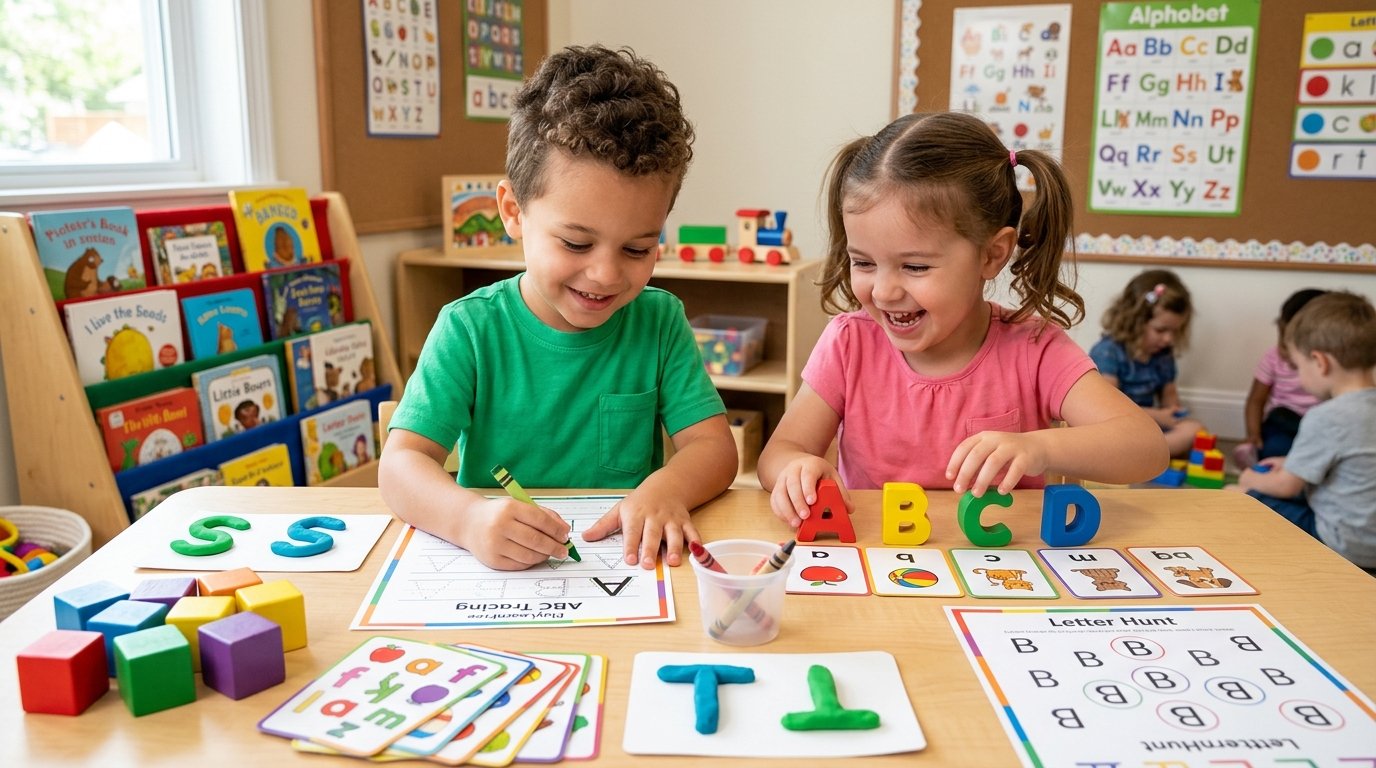
Turn learning into a treasure hunt by asking children to find a particular letter around the room. You might say, “Can you find the letter B?” and let them search through books, cards, posters, or worksheets. PlayLearnFree, for example, offers letter-hunt activities where children search for hidden alphabet letters.
8. Make Learning Multisensory
Children learn differently, so involve more than one sense whenever possible. Let them trace letters in sand, form them with play dough, draw them in the air, or make them using sticks. Seeing, touching, hearing, and moving can reinforce the same concept from different directions.
9. Uppercase and Lowercase
Once children are comfortable with some uppercase letters, introduce their lowercase partners. Explain that “A” and “a” are different forms of the same letter. Matching games can help children connect the two forms without overwhelming them.
10. Introduce Rhyming Words
Rhyming helps children develop awareness of how words sound. Play simple games such as asking what rhymes with “cat” or “sun.” Although rhyming is not the same as letter recognition, it strengthens children’s ability to notice and compare sounds, which supports later phonics learning.
11. Alphabet Flashcards
Flashcards are simple but useful for short practice sessions. Show a letter and ask the child to name it and produce its sound. Keep the activity quick and positive. Instead of continuing when a child becomes frustrated, take a break and return to it later.
12. Teach Through Stories
Stories naturally expose children to language, vocabulary, and sounds. Choose simple books with repeated words or noticeable beginning sounds. Story time does not need to feel like formal instruction; even a few simple questions can turn reading into a valuable phonics lesson.
13. Alphabet Worksheets
Alphabet worksheets can give children structured practice after an interactive lesson. A good worksheet might include tracing, matching, coloring, finding letters, or connecting a letter with a picture. PlayLearnFree provides printable alphabet resources including ABC tracing, dot-a-dot activities, and letter hunts for preschool and kindergarten learners.
14. Color Letters
Coloring turns letter practice into a creative activity. Give children a large letter and let them color, decorate, or fill it with patterns. While they work, repeat the letter name and sound naturally. This works particularly well for children who need a relaxed way to practice.
15. Letters with Play Dough
Ask children to roll play dough into long pieces and shape them into letters. Start with simple forms before moving to more complicated ones. As each letter is formed, say its name and sound. This activity strengthens fine motor skills while reinforcing letter formation.
16. Movement and Actions
Young children often learn better when they are allowed to move. Give each letter a simple action. For example, children might jump when they see a particular letter or pretend to be an animal whose name begins with that sound. Movement can make repetition feel less boring.
17. Practice One Sound in Different Words
Once a child learns a sound, use several familiar words to reinforce it. If you are working on /m/, practice “moon,” “milk,” “mom,” and “monkey.” Hearing the same sound in different words helps children understand that sounds remain consistent even when the words change.
18. Real-Life Letter Examples
Learning becomes more meaningful when children see letters outside worksheets. Point out letters on cereal boxes, road signs, clothing, books, menus, and store names. Everyday moments can become small learning opportunities without feeling like schoolwork.
19. Matching Games
Create cards showing uppercase letters, lowercase letters, pictures, or simple words. Ask children to match related cards. For example, they can match “B” with “b” or “B” with a picture of a ball. Matching encourages visual recognition and helps children make connections independently.
20. Repeat Without Making It Repetitive
Repetition is essential when children are learning new letters and sounds, but repeating the exact same activity can quickly become boring. Practice the same concept through different methods, one day with tracing, another day with a letter hunt, and another with a song or game.
21. Short Lessons
Preschool children usually benefit more from short, focused activities than long lessons. A five- to fifteen-minute letter activity can be enough, depending on the child’s age and attention span. Stop while the child is still interested rather than pushing until they become frustrated.
22. Give Children Choices
Offering choices can make children feel involved in their learning. Ask whether they want to trace, color, find, or build letters. The goal remains the same, but allowing children some control can increase their motivation and participation.
23. Letters in a Practical Order
Parents often ask what order to teach letters and sounds. There is no single order that works perfectly for every child. Instead of focusing only on alphabetical order, consider introducing letters that are easy to recognize, frequently used, or useful for building simple words.
24. Focus on Sounds
Knowing that a symbol is called “B” is useful, but children also need to understand that it represents a sound. When you teach letters and sounds, consistently connect the letter name, letter shape, sound, and a familiar word. This creates a stronger foundation for beginning reading.
25. Encourage Children to Find Their Own Letters
Give children opportunities to become the teacher. Ask them to find a specific letter in a book or point out letters on a worksheet. You can even ask them to “teach” a favorite toy the alphabet. Explaining something they have learned can strengthen their confidence and reinforce memory.
26. Printable Activities for Independent Practice
Printable activities are useful because they provide children with something concrete to complete. A child can circle letters, trace shapes, or color a page. PlayLearnFree provides downloadable PDFs intended for printing and use at home or in classrooms.
27. Celebrate Progress Instead of Perfection
Perhaps the most important strategy is to keep learning positive. Some children will recognize all their letters quickly, while others need more time. Celebrate small improvements: correctly identifying one new letter, remembering a sound, or finding a letter independently.
Final Thoughts
Teaching letters and sounds is about much more than memorizing the alphabet. Children are learning to recognize symbols, connect them with spoken sounds, develop fine motor control, and eventually use these skills to read and write. That is why playful, repeated practice is so valuable during the preschool and kindergarten years. Free printable resources such as those available through PlayLearnFree can make this practice easier to organize and provide children with fun, screen-free activities. Most importantly, remember that early literacy should feel encouraging rather than stressful. When children associate letters and sounds with curiosity, creativity, and positive attention, they are more likely to stay engaged.